
Dyeing to plant
Planting to dye

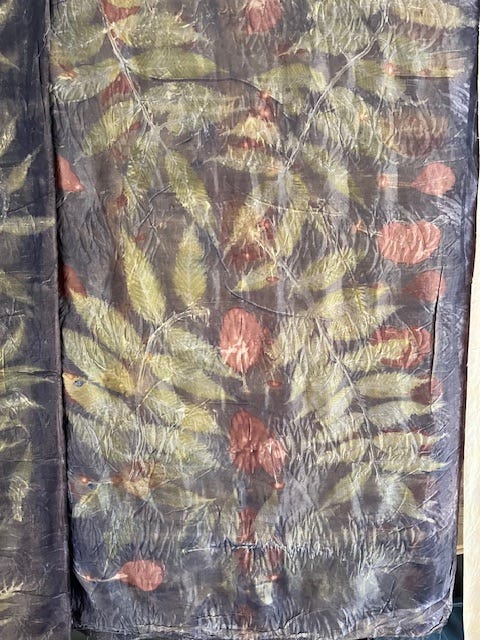
It was almost inevitable. I bought a secondhand book on plant dyes online, I received it this morning and it already had my name in it.
When I moved I had to relinquish a lot of books. Well I didn’t absolutely have to but I had many hundreds of books and didn’t want to put them all in storage for a year, I didn’t want to fill my new much smaller house with books I might never seek out again, I didn’t want to build bookshelves and fill every space. So I got rid of 27 crates full, I didn’t sell them as I just had too much to do and sort and get rid of, and efficient selling was just one thing too much to think about. They went to Oxfam, were donated to other second hand bookshops or given to anyone who wanted to give them house room. I kept a few hundred favourites but was pretty ruthless. I distinctly remember filling a whole crate with books on plant dyes and plant uses, I remember thinking “That era is past, I shall never need to consult these again, they can go.”
I suspect that’s always what happens, I make a conscious decision and it is proved faulty. But perhaps if I had kept those books I would never have got back into dyeing? Something else that I shall never know.
I can’t remember a time when I didn’t love plants, a continuous delight from early childhood. Gardening seemed pretty boring, I was not at all interested when my mother tried to teach me about weeding, I thought she was unreasonable to be cross when I pulled up a whole row of carrots to try to find one that was ready. But I loved the land, I was probably no older than seven when I spent most of the summer holiday going out on my pony straight after breakfast with a dog and spending most mornings on my stomach looking at the flycatcher plants round the bogs on the nearby moor, trying to tempt flies on to their sticky surfaces and watching their tongues crush the hapless insects. Or crawling slowly through the old pasture fields trying to find four leafed clovers, or finding the sweetest watercress in the stream by the ram that pumped the water for the farmhouse. I loved gathering bilberries on the high moor, discovering different mosses and lichens, finding white heathers among the pinks and patches of delicious smelling wild thyme. I can remember the peaty smell of sunwarmed bog edges, how the grass was springy in some areas, solid in others and soft and slightly dangerous when it was azure green. The feel of the ground changed where the bracken stopped and the heather began, I remember how the rowan trees grew at unlikely angles high on the crags above the huge ancient and slightly creepy beech avenue by the castle.
My only strong memory of prep school – apart from the eau de nil silk Greek-style dancing tunics that we wore to cavort around the statue of Flora on one of the outside terraces – is the wildflower competition each year. We were all allowed out into the wider grounds, hundreds of acres surrounding the school, and permitted to pick any flower or grass that we could name – I think in both latin and the common name. One year I won the competition with 91 stems. I wonder how many of them still grow there, and I wonder how many I could now name, not many I fear.
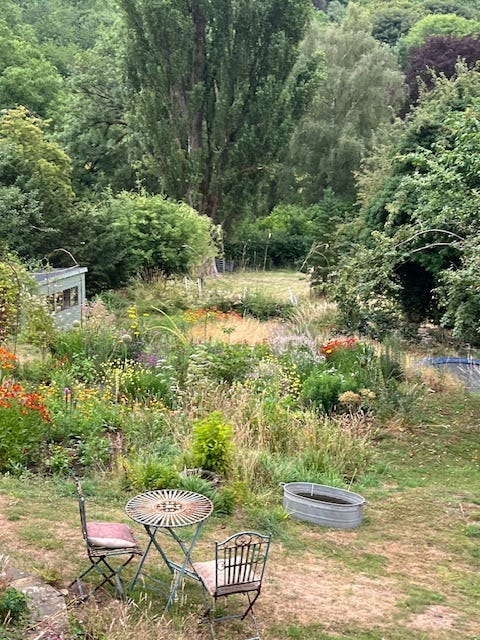
That was all some decades ago, I have had many gardens of my own since then, including the two commercial cutting gardens, and I have never lost my love for plants. People say that it generally ruins a hobby to turn it into a business but that wasn’t my experience of growing, it was such a joy to have the opportunity and the justification to grow virtually anything I fancied, with no limits of space or design. However, and this has come as a surprise, I absolutely love my new much lower maintenance and so much smaller garden, it is giving me enormous pleasure, I love looking at it, I love being in it and among the plants, I love deciding what to do next, all with absolutely no pressure. I have a fairly sizeable list of additions of useful dye plants to include this autumn and winter but I am actually quite surprised and delighted by how much I am enjoying it already. And it is leaving me free to work with plants in an entirely different way.
Which brings me back to books. The dye b
ooks I am recollecting are useful, but perhaps not all that useful. They tell me the basics, but I probably already know the basics, the only way to find out what really works is to get stuck in. One of my favourite discoveries has been the lovely blush pink colour that can be processed from flag iris root, I love the glorious tobacco-ey brown from walnut leaves, and the shining silverywhite glow from printed white poplar leaves. I have discovered that some tannins are too strong for silk but perfect for wool, how leaves may produce completely different coloured prints on different fabrics or when combined with different dyes. I’m struggling to get a good strong green without several stages of over-dyeing, marvelling at the way madder can produce tones from darkest rich blood red to pale orange, how rhubarb leaf is an essential. I have a pot filled with water and rusty iron, another with copper pipe immersed in water, a bucket of wood ash from the stove going slightly slimey under the workshop sink, all have their new uses! It is an absolute joy having a workshop/studio again, already filling up with treasures of all sorts!
Last year I sprinkled marigold seed when I eviscerated the bamboo from my garden, just to get something jolly going while the garden was an extension to the building site. I’m not quite sure why I did that as I don’t much like them and they can take over. I tried to stop them from seeding everywhere but failed and loads came up this year. Happily, they have been very useful for the dye pot – but I’m not encouraging them to stay next year. I brought some clumps of anthemis tinctora with me because I love their pale yellow daisies not because they are a dye plant, but they have done extraordinarily well and are proving merrily useful. I’ve planted inula, weld and madder, coreopsis and cornflower and many others for the dye pot, but at the moment I am most enjoying foraging for foliage. Which is one of the things I remember enjoying hugely when I started my cut flower business all those years ago! I have always enjoyed searching out the unusual to add to the more conventionally beautiful.
One of my greatest friends, who now has her own very successful cut flower business with her daughter, gave my new dyeing venture the seal of approval. “It’s completely perfect for you Charlie, it is working with plants, it is highly creative – and it is extremely messy.”
charlie, your friend knows you well! have lots of platerly fun!
I have been growing dye plants for many years, mainly because the history of textiles interests me. I got a lovely American book some years ago called A Dyer’s Garden by Rita Buchanan . It is very well laid out with growing conditions and recipe for using each dye plant and swatches of fibre down the side of the page showing different results with different mordants. It has been out of print for years now, but I have a few copies I have collected if you would like one. It was where I discovered Japanese or Chinese Indigo, which is MUCH easier to grow and use that the normal Indigo, in the British climate anyway.