
Clamour
And another garden story

Clamour and turmoil. I have felt a little overwhelmed by all the major issues affecting so many this past year. Ukraine, Gaza, Iran, places I may never visit but which have driven themselves into my consciousness. Trump and his lowering and oh so toxic influence along with the seemingly unstoppable rise of the right wing and their prejudices, the decline of intelligent personal communication and the rise of the virtual and the artificial. I am not a pessimist , I don’t believe the rot will last for ever, the clamour will subside, but writing about the garden seemed a little unnecessary. The joy of plants and gardens is that they will adapt, you can leave them be and things will change but something positive will happen even if it is not by your design or desire. The joy of being human is that we can change, we can make changes even if we can’t always influence what is happening in the rest of the human sphere.
I needed to turn to something practical. The last time I felt the strong urge to do something practical I stopped writing as my prime job and turned to flower growing. I dove in and gradually turned several acres of rotten old pasture into a field of flowers. I was much younger then and had the energy to move mountains (almost literally). It was exhilarating, exhausting, joyous, nerve-wracking, hectic and led to over 20 years of a reasonably successful cut flower business. Last year, three years after stopping the flower business, I got that itch to do something practical again, perhaps unconsciously concerned it would be too late if I didn’t do it now. Plants always need to be at the centre. I don’t miss looking after acres of cutting flowers or all that goes with that, but I very soon found that I missed being practically involved with plants. I love plants, I love what they offer, what they symbolise, what they mean to me, and I am really enjoying working with them in a different way, making dyes, printing with leaves, making more dyes and creating successful and less successful textiles, from scraps to fuill size curtaining. I have no fantasy that this current obsession will become a very lucrative business, but I hope it will bring joy to the people who do see and/or buy the textiles I am producing. And I so enjoy the processes involved.
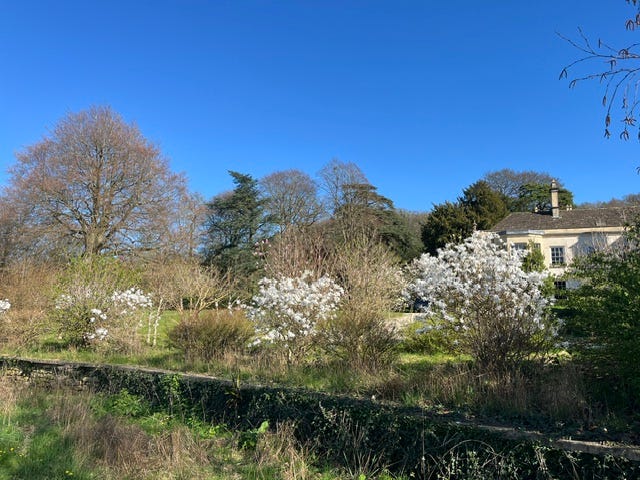
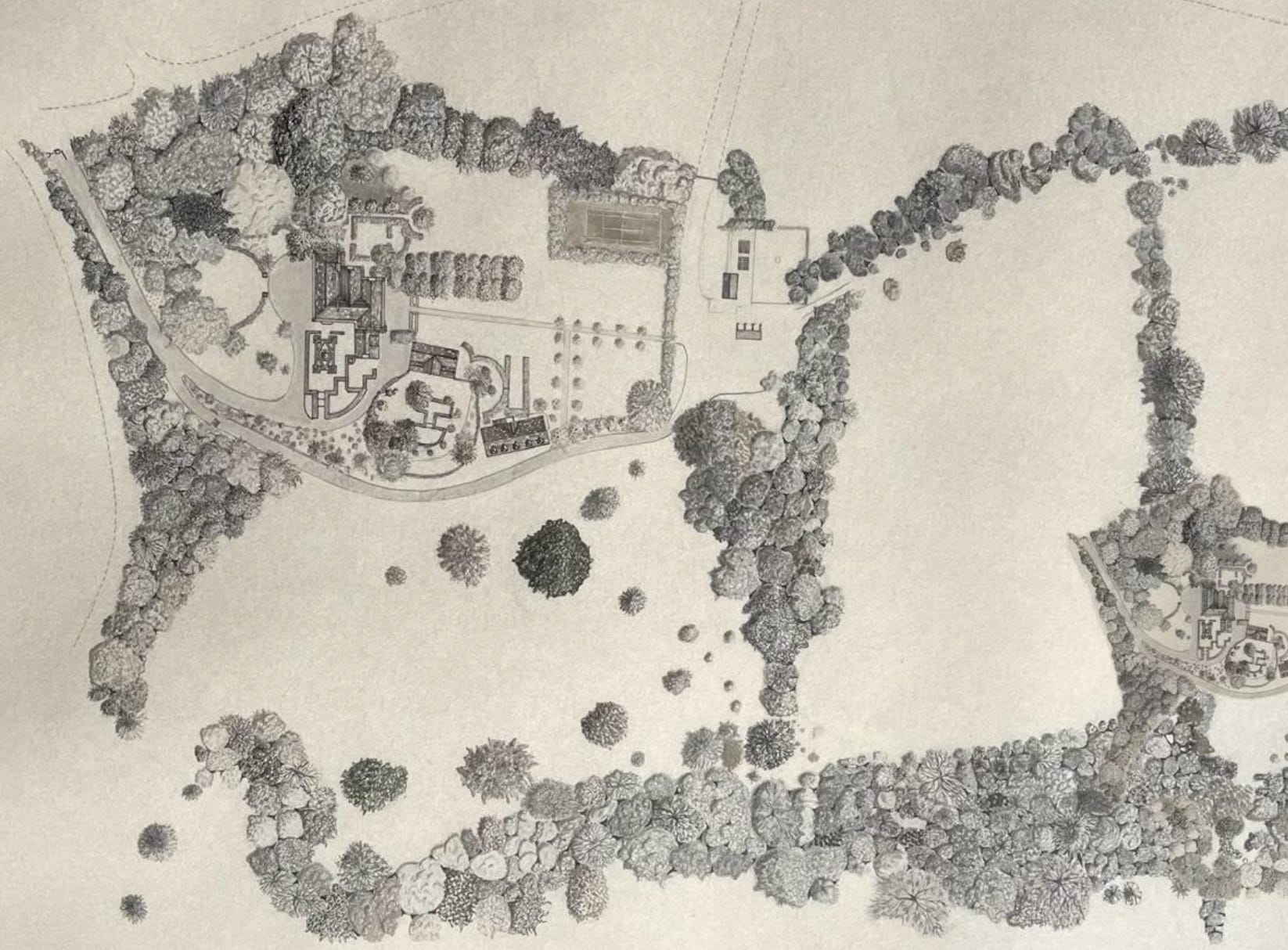
Meanwhile, a remarkable opportunity came up earlier this year to dive into another garden, to help the new owner of a reasonably large historically landscaped garden attached to a small historic mansion. Several years of near total neglect had taken their toll though it was obvious that various owners had cared deeply about the gardens and waves of tree and shrub planting had swept through the acres over the past decades and centuries. The trees and shrubs were astonishing despite neglect, not only historic old treasures but also some special plantings in the last 25 years. Huge parkland trees, sweet chestnut, red hazel, oaks and beeches and swathes of enormous mistletoe-covered weeping willows in particular roamed the park to the West. Fairly recent walkways of crabapples formed a cross on the top lawn and a historic beech and copper beech allee separated the main garden from the original croquet lawn.
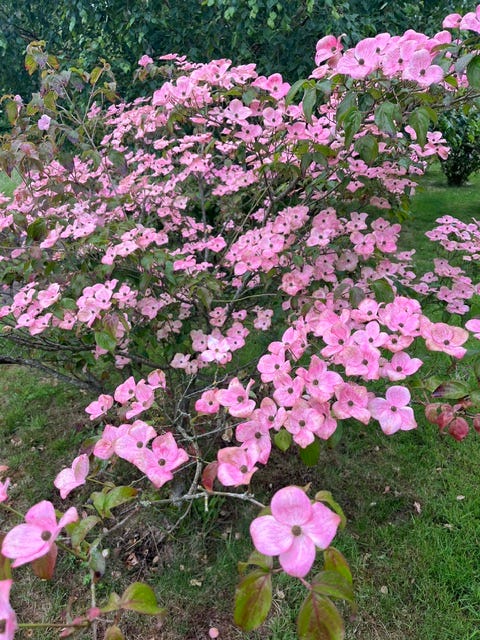
I’ve never before seen a cornus kousa about 40 feet tall, keeping pace with its Norway maple neighbour. I counted eighteen varieties of smaller cornus, including two glowing red forms, presumably some sort of C kousa rubra. There were turkey oaks, sessile oaks and northern red oaks, yellowwoods and cape myrtles, heptacodiums and jack trees. At the end of the beech allee towered a magnificent sweet chestnut. But one night, in a not particularly strong storm, it tumbled heavily to the ground. Its heartwood was sound and there were no obvious signs of disease. I called in a tree surgeon who suggested it had succumbed to drought as the area was drying out fast due to changes in climate.
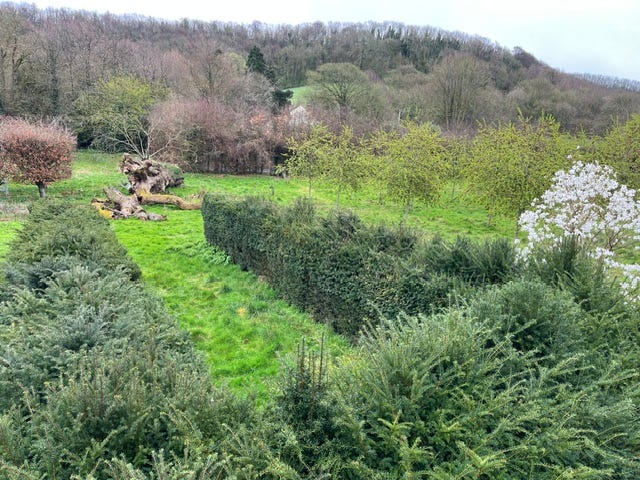
Both high and low yew and box hedges separated discrete areas inside the tall beech hedging that surrounded the main garden on the south side. To the north , opposite the entrance to the Georgian front of the house, was a yew enclosed circular lawn with a classic fountain (not working) and a substantial intricate box parterre, now filled mainly with ground elder and foxgloves. Along the drive were crinodendrons and styrax among a host of different viburnums, and magnolias ranged from small Stellata to magnificent mature sieboldii, and some deepest red and pink forms I couldn’t name.
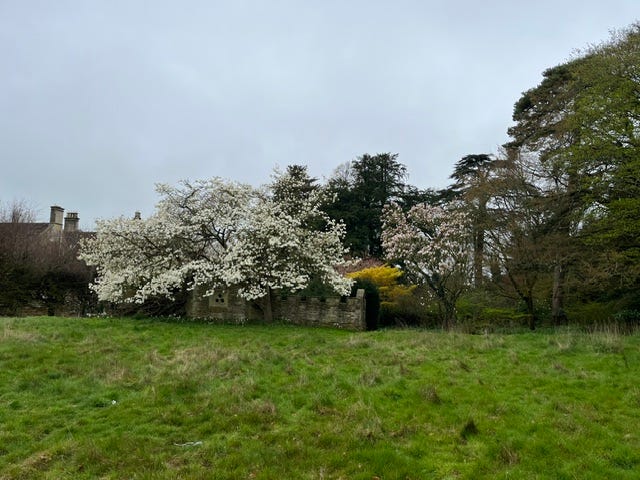
A white flowering soulangeana presided over a small enclosed garden of ornate stonework where pillars were crumbling and angels had fallen from their heights, it must have been 30 feet tall and spread, and a deep blue wisteria happily clambered through it. A beautiful sight in late spring.
.
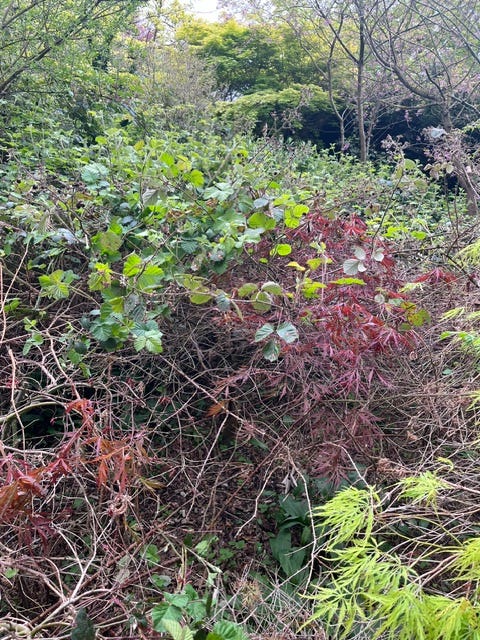
Yew hedging had in places absorbed stonework, a full covering of ivy and brambles had started to eat the ancient red brick walls around a once ornamental walled water garden, bricks were beginning to fall out when the wind blew. Perhaps saddest of all to me was the Japanese inspired garden to the west of the house where a significant collection of acers had been completely covered and crushed by brambles, strangling those whose branches it failed to break or squash.
I couldn’t help but be entranced by the gardens, or their potential. And the owner was mysterious - young, glamorous and seemingly totally in love with her extraordinary house and garden. Could there be anything much more exciting for a gardener than walking in to an unrestored garden with excellent bones and great trees. And being offered the opportunity to bring back echoes of its former glory while moving it in to a sustainable 21st century paradigm? At the beginning I didn’t much question how the gardens had got into that state, focussing, I freely admit, on the magic as much as the reality. I ignored the many red flags that suggested something might be a bit adrift. Stumbling across such a place was extraordinary, both exciting and bewildering., but it became increasingly curious.
Mine was initially to be a very part time role, to create a plan of action and make decisions about both the design and future role of the garden. Once we had got the bones of the plan sketched out with an appropriate budget, the intention was to put the funding in place to employ whoever was needed and move into the serious restoration and redesign phases.
The new owner was not entirely new. She had been there for two and a half years yet even the large lawns around the house had not been touched for almost a year when I arrived, and only mown a few times before then. so I set about putting a maintenance plan in action for grass and hedges as priorities. I didn’t really question why nothing had been done since she bought the place, assuming she must have been busy on the house, leaving the gardens for stage two as she had never taken charge of a garden before. I figured she had perhaps been ill advised as she simply hadn’t factored in the importance of ongoing maintenance, leave alone restoring quarter of a mile of beech hedges that were becoming tumbling trees, or checking the ornamental avenue beside the house that was by now dwarfing the Elizabethan façade.
She took me on because she expressed a strong urge to get some energy into the garden, to encourage possible participation from other organisations, to open access to the gardens as well as getting on top of essential maintenance. She wanted general publicity and features about the place as it developed into her dream members club grounded in nature, and expressed an interest in collaborating with other gardening organisations. There was even preliminary discussion about using the place as potential training garden for Garden Masterclass courses.
At least that was why I thought she took me on. Of course I was thrilled by the prospect of bringing a once wonderful garden back to some sort of life and future, I was thrilled by her enthusiasm as we discussed the possibility of getting maintenance underway and planning to develop a totally biocentric garden and eventually replanting huge borders and discrete gardens within the garden with totally appropriate plants. There were plans to be made, schedules to be created.
However. I was surprised that the owner had taken on the place without any plans for the garden. More than slightly taken aback when it turned out she knew nothing, and I mean nothing, about gardens and plants although her vision for the place was centred on nature. She intended or wanted to create some sort of exclusive nature-led retreat/members club. Which didn’t quite fit with the idea of opening up the gardens but I decided to be blind to the increasing plethora of contradictions and enjoy the chance of moving the spaces forwards. Even though I am always forcefully against the idea of using nature as a commodity and that seemed to be at the base of her idea.
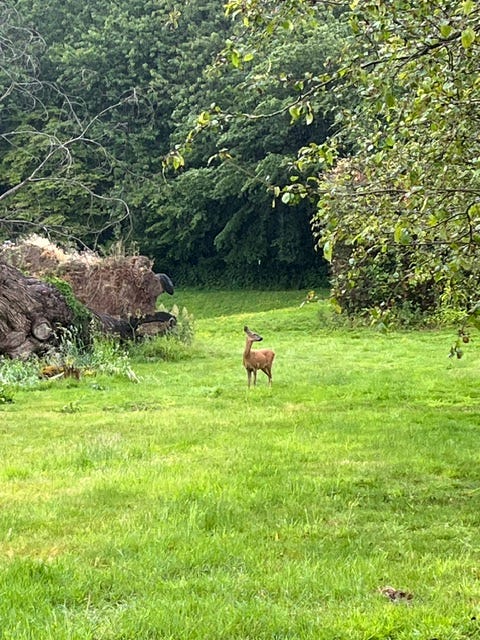
She did have ideas. But it took little time for me to realise that she had absolutely no real plan of how to make those ideas happen. She pulled notions down out of the air and wanted to run with them until they ran out of steam, which could be half an hour or several months. But always ended up in the same place, a steaming midden. The gardens were fearfully overgrown but full of flowering plants – by June roses took over whole buildings, alliums, iris, nepetas and peonies flourished everywhere as deer don’t like them, yet she went to the supermarket and bought sad-looking flowers which she truncated and stuck in bud vases on her kitchen table.
She wanted to set up a volunteer scheme, but was slightly irritated when I emphasised that volunteers weren’t just free labour but there needed to be a quid pro quo, and a scheme needed to be properly organised from the start. I suggested her idea of giving them cheap access to the hypothetical tennis courts or priority booking for hypothetical events wouldn’t wash it. She wanted the double stretch of 30 metre long and 3 metre wide herbaceous borders brought back instantly although they had become totally overgrown with ground elder, with little more than a few alliums, peonies, nepeta and iris poking through, and an occasional clump of veronicastrum. It took several conversations to tell her how that wasn’t going to work, it couldn’t be a priority given other works that needed to be done and would be a big job involving digging the borders out completely and replanting. It took several more conversations to tell her that she couldn’t have the borders she wanted while still allowing the deer she liked to continue roaming the gardens. “Could we plant an area specially with plants they do like to keep them off the borders?” I told her it could be interesting to work entirely with deer-resistant species but as she was still going to have to put up deer fencing to keep them off her hypothetical restored croquet lawn so it would be much more sensible to start by fencing the garden properly. She found it difficult to get to grips with the notion of restoring the gardens gradually in a specific order with a proper schedule, plan and budget. I suppose she may simply have felt overwhelmed.
I was allowed to get in some part time help to try to bring one discrete ornamental garden back to life so there was one area near the house of the gardens that could return to a pretty ornamental space in which to sit and ignore the wider chaos. I was allowed to get in some excellent tree surgeons who worked magic. And of course I found someone to cut the substantial areas of grass every week or fortnight. He was a pleasant young man building up his business and he really tried hard and did the best job he could, bringing the large southern lawns back from a tussocky mossy mess to some semblance of flat grass within a few sessions. Apparently the owner had tried to get contractors before I appeared on the scene but no one stayed and I began to understand why as she liked to micromanage the grass cutting from an upstairs window (literally) and would then complain to me about how long it was all taking etc etc. Although she knew nothing about gardens, she had some extraordinary vision of how things should be done, gleaned from, I think, social media rather than life.
She seemed alternately excited by or terrified by her project.
The house had been bought at auction, sight unseen, from particulars created 8 years before when it was originally bought by an investment guy who had gone bust, hence the property had to be sold. However, tenants had been living there with a vague repairing lease and expected to be there for at least another 5 years according to the agreement they had signed. They refused to leave as they believed they had the security of their agreement. Prospective buyers were not allowed to visit and look round as the tenants believed it should not be for sale. So the house was sold without anyone looking round and with sitting tenants. Bizarrely, the new owner was not the sole bidder.
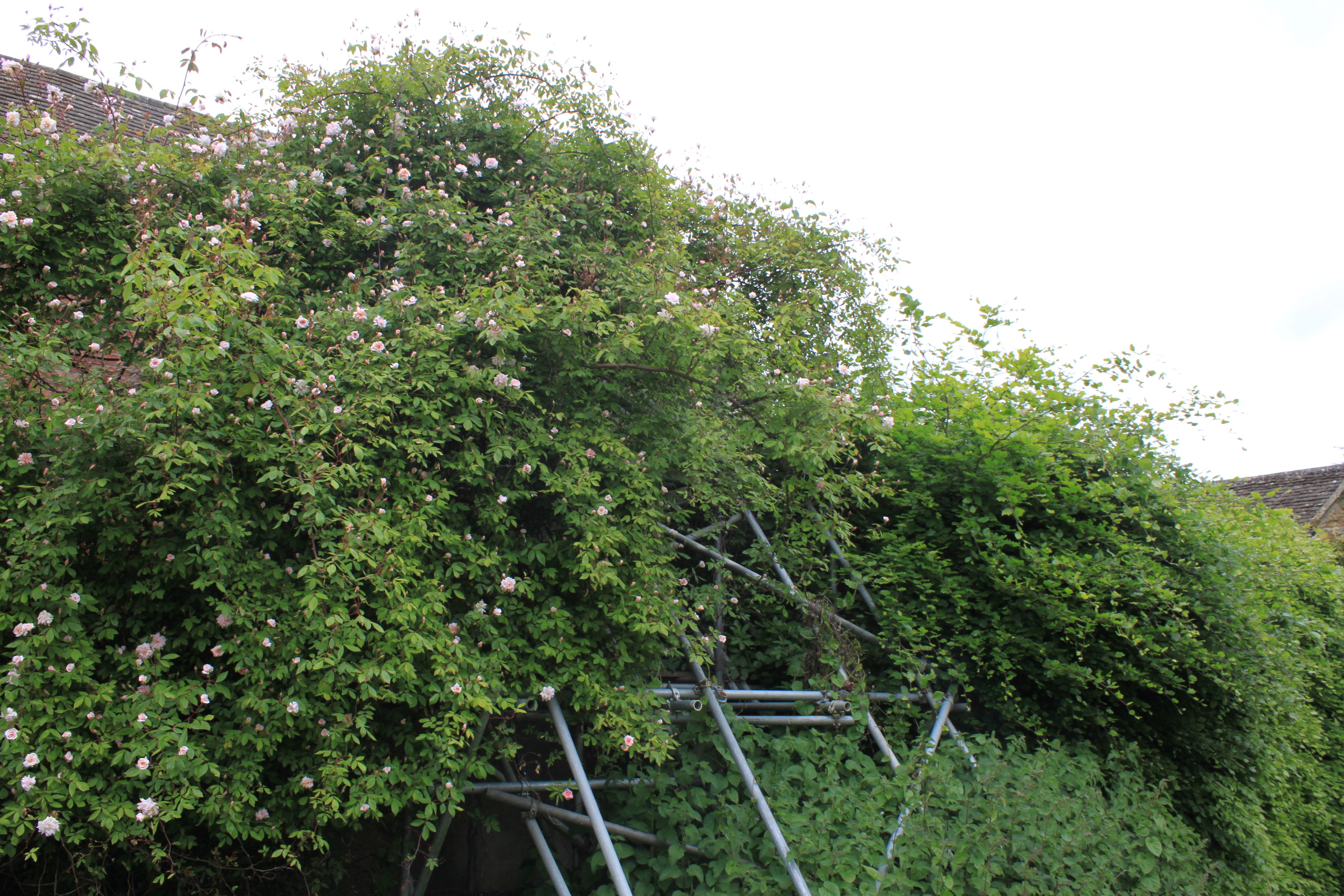
She believed she would have the necessary funds, if not from her own portfolio but via investors and future members. But it wasn’t working out like that. She had apparently calculated some idea of costs, but had forgotten somewhere along the line that she would have no income from her investments as she would have ploughed all her capital into the house. So she was quite literally broke. And looking for handouts. With, as far as I could tell, no particular project schedule, no research into planning and conservation issues, no consultation processes, no land agent, and vitally, no builders. It transpired that she hadn’t had any professional builders, she had had quotes from conservation specialists and relevant firms but hadn’t taken anyone on, had just cobbled some rooms together with the help of friends. It all seemed extraordinary, especially if you took a proper look at the house and noticed the failing roof, the rotting windows, the unpointed wet external walls, and the beautiful gabled coach house that was held up with complicated scaffolding and the biggest Cecile Brunner I have ever seen, but little else. I don’t know anything about the kind of speculative financial arrangements she was envisaging but I quickly became more than distinctly uneasy. I felt it all had a whiff of the Sarah Fergusons about it.
It quickly began to feel like a total car crash in waiting. The owner seemed to be indulging in some sort of extravagant magical thinking, with glimmers of reality becoming ever more elusive. And despite her professed passion for wellness ( a word I loathe), she seemed to be fading away weekly, losing her grip on her personal health at the same time as the bigger picture became increasingly overwhelming and impossible.
Ironically, it was a car crash that would keep her afloat for a few short months while she sought the investment she wanted. When I met her she was driving an almost new SUV Bentley. Within two weeks she had written it off. She had another vehicle and the insurance money from the Bentley became her only cash.
After a few weeks of increasing unease I suggested she came and talked to me about whether there was any real future in trying to take the gardens forward if she currently had no money. We could meet in the nearby town or she could come to mine if it was more convenient but I wasn’t going to come over to the project where any conversation would be quickly derailed . I wanted to have a proper discussion as I saw no point in wasting time and energy and hope on something that was never going to happen, and frankly I needed to get on with my own work and fast if this was a dead end. She arranged to meet me twice and bailed out. Then phoned one Sunday morning saying she’d like to come over later. I slightly unwillingly agreed.
She arrived with a man friend man in tow, not having told me she was going to be accompanied. She was vivacious, flirty, pretending to be in control. I was slightly stony but not going to put her down in front of her friend who it turned out was in the process of creating some high end wellness retreat/members club/hotel using everyone else’s money. He was obviously bright, full of ways to do it all, and the thrust and networks to make things happen. She was treating me as if I was her employee and devoid of any experience. I was seriously unimpressed but let her get on with it then sent them packing as soon as I could.
I forgot to mention she is all of 42 years old, only discoverable on the internet as a “Brazilian socialite” and said her working background is “Fashion and wellness”. She is initially immensely likeable. I soon realised why she cannot keep anyone working for her, quite apart from the finances. She is obsessively compulsive about tiny details with no idea of a big picture and sadly not mentally robust enough to see any project through, let alone something on the scale that she had seemed to have taken on. She was big on buzzwords, spoke about regenerative agriculture for example with most of her knowledge about it seeming to come from posts on Instagram. She seemed incapable of seeing the bigger picture for more than minutes. She absolutely had no idea how rural life operates and seemed paranoid about the local populace, and saw her future community based on people who live in other large houses rather than any sense of potential integration. None of this was a sensible recipe for taking on a huge project. It was extraordinary, she spoke of transforming the place into some sort of working space but absolutely without the necessary psychological or, it turned out, financial means to do so.
Of course everything fell apart for me after her churlish visit with her chum. It was obvious there was not going to be any straightforward kind of trajectory forward. I had set up meetings with ecologists, the wildlife trust, tree surveyors, a volunteer organisation, garden charities and nurserypeople but all for nothing so I cancelled them all rather than wasting anyone else’s time. She didn’t seem to realise that time wasting is not acceptable, most people are just trying to run businesses and make an honest living. When she suggested I should make all the contacts for her to sort out her (lack of) security situation it was long past time to drive away.
But I did have mixed feelings. I felt fortunate to have spent a few months in and out of what was a very special place. Sad not to be able to carry anything through, and angry with her utter lack of seriousness. If you take on an extraordinary property with a very special garden, park and landscape, you owe it to that property to do your best by it. Or so I believe.
I don’t know if the house is up for sale yet, or if she is struggling on in her uncomfortable fantasy world, still imagining her beautiful swimming pool and natural swimming pond, her yoga pod in the woods, tennis courts and a new perfect croquet lawn. She even imagined building a barn restaurant in one of the fields and supplying it entirely with home grown produce. It sounds laughable, but I was briefly taken in by some of the ideas because I wanted to be. It was frustrating as I always felt that if the owner went away for a few months and I came in with good garden and tree help we could have transformed those gardens into beautiful low maintenance – and low frill – spaces in no time. The structure is already there, no hard landscaping is required at this stage, just the will and a sensible budget.
I felt quite invested in the place while I was there for those three short months, but after I left I was very quickly relieved to be totally ghosted by the owner after dozens of messages a day, some querulous, many just links to social media spamming up my airwaves. It was an odd experience, but I was pleased to have spent time there. In some ways I was pleased to have met the curious young Brazilian, although I am still waiting for some payment, and I really hope the right person does emerge to be its future custodian
.
I did feel sorry for her, but I confess that waned! I feel sad for the gardens as they deserve to be cherished, by someone who appreciates what is there. It all held such hope. But all too brief!
What a story! I've had a couple of false starts with airheads or fantasists but nothing on this scale. I ended up feeling sorry for her, and for you - i know that sense of hopes dashed only too well.